Uncategorized

How do you feel about gefilte fish?

Printed in the Kansas City Jewish Chronicle on March 12, 2026

By: Sara Nicole Glass, Director of the Weiner Religious School


There is one kind that I bet all of you might actually like… A bold statement.
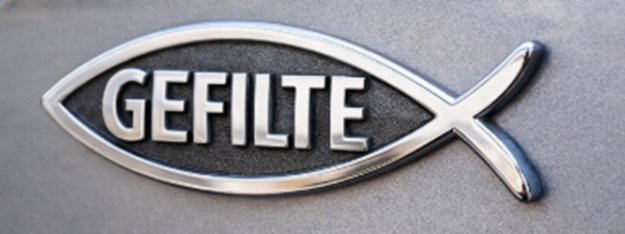
If you have ever walked through the synagogue parking lot, you may have spotted a grey fish on the back of a car with an unusual word in it. Yes, it’s a fish shape that is often associated with a Christian symbol — except this one proudly says “GEFILTE” in the middle. Yes, a gefilte fish car emblem, which ideally makes people smile. That’s right, I have not just one, but two Gefilte fish on my ride. Why? Yes, I have an agenda, and the intention is to make people who know giggle, and also maybe to allow those who don’t know to wonder.

Believe it or not, that little fish represents the very heart of who I believe we are as Jewish people, creating space for asking questions, while keeping our sense of humor.

It is a reminder that being Jewish can and should be joyful. Judaism is serious when it needs to be, but also can be playful, funny and full of cultural zest. I saw this particular silver gefilte fish emblem years ago at a store [It’s a Beautiful Day – 3th and Broadawy”in MidtownKansas City and had to have one. There has been one hanging on my car (almost) ever s) nce. Ironically, the only time it was stolen was when I was at a Shabbat dinner event last year. So of course, I found a new, slightly different version, after which I found the original one (which I could not locate anywhere for about six months), and frankly I liked the silver simpler one better, probably because while gefilte fish is uniquely part of our collective Jewish identity (or so it seams, around Passover), this little symbol also speaks to so many other people for what they need it to mean.

For me personally, it symbolizes the way we live: rooted in Jewish identity while at home in a multicultural world. While I was raised Jewish, my grandmother was Catholic, so I’ve always been exposed to different faiths, even though I identified as Jewish. I was taught that there are many different ways to identify, and that is okay. That silver fish has become a well-known symbol, but creating a Jewish twist on it, I’d like to think, is something quintessentially Jewish — acknowledging our neighbors’ traditions while joyfully contributing our own voice and humor. My gefilte fish isn’t mocking anyone; it’s simply joining the conversation with a bit of chutzpah.

Also, it highlights the idea that humor is part of our theology. Judaism adapts, evolves and meets us in our everyday lives — even in the parking lot at the grocery store. A silly little fish with the word “gefilte” inside has become a playful theological lesson: Judaism is alive and on the move!

I love that it serves as a conversation starter about Jewish identity. People ask: “Wait, does that say… gefilte?” Then we get to talk about Judaism — not the formal, textbook version, but the lived version filled with food, stories, music, culture, humor and community. In those small encounters, the gefilte fish becomes a tiny ambassador for joyful Jewish life.

I’d like to think I’m driving around, trailing many of the core values of Reform Judaism: joy, openness, cultural pride, pluralism and the belief that Jewish identity should be lived out loud and without fear. It’s Judaism that is confident but not exclusive, grounded but not rigid, proud and always welcoming. That’s what we teach our children, model for our teens and practice as a community.

So what does the gefilte fish on my car really mean? It means I believe in a Judaism that laughs, learns, evolves, welcomes and delights. It means Jewish identity is something we can carry proudly — whether on our hearts or on the back of a car. And it means that even cruising down I-435 can embody living a joyful, Jewish life.

Call it a mitzvah on wheels, but please, don’t steal my gefilte fish!

Send any fun Jewish humor that comes your way to sglass@beth-torah.org.

Religion

Still Jew-Ish

I am often presented with the imminent wonderings of… “hey…. you’re Jewish!  How does it feel!?! …. I’ve always wanted to take to a Jewish person about Judaism…I knew a Jew once….”

My response: “Awesome, I LOVE the Jews!  YES Let’s talk about  being Jewish… it’s.  It’s wonderful.  It’s everything.  It’s… I got nothing”

“So like… do you believe in heaven or hell?” is usually the next question I get.

My response: “Do you?”.

That being said… year’s ago, I asked MY Rabbi this eternal question of heaven and hell.  Earnestly. With my big eyes, looking at him, knowing rightfully so that I probably would have known that answer to that if I paid attention at Hebrew School.  He looked at me wistfully, and then handed me what must have been an 1,000-page book and said “I’ll answer you that question after you read this book”.
Really, there just wasn’t a simple answer.  There never is to a good question.
Judaism, simply put, in my view, is about choices.  Are you Reform, Conservative, Orthodox or Hasidic? (I’m Reform, the easy one).  Do you keep Kosher or not? (We didn’t).  Do you want to have a Bat Mitzvah of not? (I did, though my parents really didn’t care either way, mostly because they didn’t want to foot the bill, I speculate).  We were always frugal.  But always had plenty of money for what mattered.   Judaism taught us: Family First.  Always do acts lot loving kindness.  Be nice to your neighbors.  And really, I grew up being taught that God is everywhere, and God is you and me and this food and my clothes and it is all encompassing.  It is nothing.  (Ein Sof)
While there are at least two sides to every story, there are about a billion takes on this ONE collection of stories. It really all started with THE BIBLE, and us Jews specifically like to focus on the Old Testament, we call it the Torah.  The first five books of Moses.  But what about the other books, I always wondered?  I mean why these five, and some of the others, but not all of them?  Why did we go so wrong with Jesus? SO MANY QUESTIONS!!!
Welcome to the never-ending story….
So, I’m having lunch with my OTHER Rabbi just last week, and I ask her the same question, “do we believe in heaven and hell”? and the answer I got is “sorta, it’s complicated, do you?” and she then proceeded to break down even further about these ancient texts and books I wasn’t entirely aware of.
Enter: The Talmud. The Talmud is the central text of the Rabbis.   It’s a collection of stories and conversation had ABOUT the Torah.  It is composed of two parts, the Mishna, which are documentation of the oral instructions and teaching of the time when the Bible was written.  Gemara is the other part, which are writings of explanations that the old Rabbi’s marked as worth being printed, as to clarify what was being said in the Talmud.  Are you following me?  I’m barely there.
Being raised at a local Kansas City Reform synagogue, that I now just so happen to work at, I can safely tell you, I feel very confident and comfortable in my “Judaism”.  But it’s not something that I can entirely explain or even begin to translate, just what it is about Judaism that pulses so strong…that feels so good.  I do feel it.  Even though I don’t always acknowledge it. Then again, I think EVERYONE can feel the pulse, whether you are jewish or not, but you have to tap into the well, intentionally.
When I got the job working for the temple, MY Rabbi (who I had known since birth), asked me to house sit while he was out of town.  It was a lovely home, and I regret not spending more time there.  One quiet evening I came by to feed the fish, I walked up to his giant bookshelf and said “show me a book… give me my book”.  I reached up and pulled out without hesitating: “God is a Verb” by Rabbi David A Cooper.  “Kabbalah and the practice of mystical judaism”. “PERFECT!  I’d always wanted to study Kabbalah”, I thought to myself.
You’re supposed to be a 40 year old male to even consider studying the Kabbalah (which literally means: “To Receive”).   Some say Kabbalah can only be learned from a gifted teacher.  Others say it comes in the school of Ecstatic reality.  Some tap into the akashic records of universal everything.  God is everything.  You are everything.  If you can believe it’s possible, it just might be true.  But it’s up to…. you choose what you believe in.  What I’m saying is, I fell in love with this book, this concept of God being a Verb.
“Kabbalah is not a system, as some suppose.  Rather, it is an outlook, a way of perceiving the nature of reality In Essence, Kabbalah is founded upon mystical conceptions regarding life, death, creation, and creator.  it teaches us about the mysteries of life, how the creation works, where we are going, and how we get there.” – God is a Verb
God is an action.  It is how you treat people.  It is how you chose to live your life.  With kindness.  Dignity. (And maybe a hint of magic and wit).  While I will continue to read this book from start to finish over and over again, probably for the rest of my life, attempting to understand just a bit more each time, I have accepted that none of us will ever know the full true story until we are gone.  We can only enjoy the ride, and hope it’s entertaining enough to take care of yourself and live healthy, happy and holy.
My father, who is now an active member of a local orthodox synagogue here in KC, is rather devout, and there is so much pride in his prayer.  And why I love it, I don’t know that I could give my life to it.  I’ve thought about Rabbinical school, but it seems limiting.  I wish I could fit myself into the nice box of religious understanding, but it just doesn’t seem to work that way.  So I still say, “yes, I am jew-ish.  I can’t tell you a whole lot about it that makes much sense, but I can tell you what’s working for me.”  And why I may not entirely understand the weight I am carrying, I too will remain prideful and humble in my faith.
“I am he as you are he as you are me And we are all together”
-The Beatles
As if that wasn’t enough for you… Jew-Ish Spoken Word Piece:

Love All Ways,
MissConception
www.themissconception.com