I attended a Citizen Lobbyist Training in Topeka, Kansas on Tuesday, March 14th, and walked away with several skills I felt useful to share with you here. This particular training was a precursor to a Mental Health Advocacy Day at the Capital.
The goals for the day were to:
• To learn specific tools about preparing for a meeting and communicating with these legislators on advocacy day.
• To establish a relationship with KS Representatives and Senators and maintain communications with them in the future.
• To receive action alerts on key legislative issues
• Organizing and participating in local meetings with elected officials to address these specific mental health issues
The training started off with an emphasis on developing our stories. The theory is that real stories change hearts and minds, and that there is hope in telling a story of recovery or change. Emphasis was put on not overwhelming anyone with too much information, and to always ASK at the end for the legislators support. A ‘story’ consists of an introduction, what happened, what helped, how you are different today, what is the need or problem, what will help others, and the ASK.
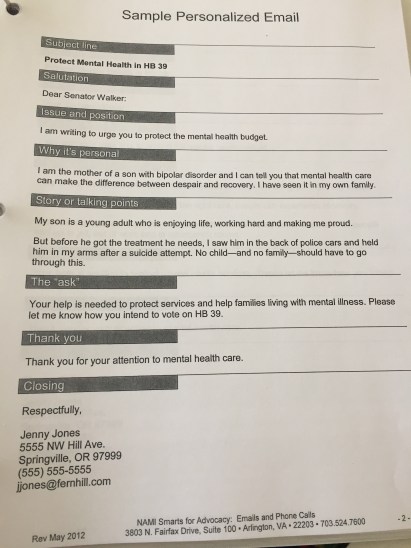
We were given examples of emails to send legislators when setting up the initial meeting, which exhibited: a subject line, a salutation, stating the issue and position, making it personal (optional), adding story or talking points (optional), making the ASK (either on the specific support, or asking for a meeting), a thank you and a closing.
Example:
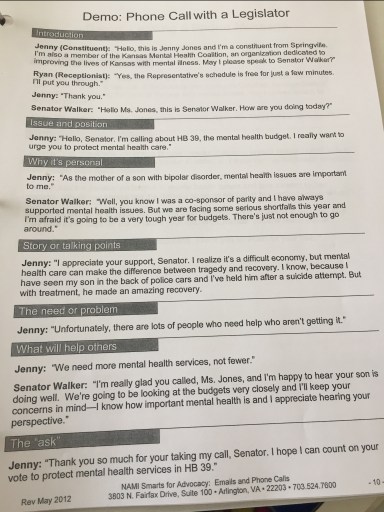
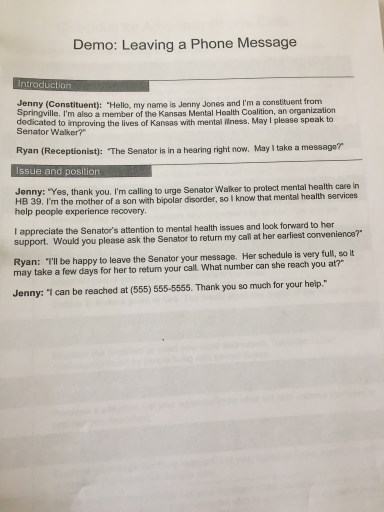
We developed our 30 second elector speeches, which again included the introduction, issue and position, why it’s personal, the need or problem, what will help others, and the ASK. A similar model of a phone call was also demonstrated.
Example:
When preparing for the actual meeting of the legislator, we first developed our tool preps for the meeting, which included a briefing sheet, stating the issue, the ASK, the need and talking points plus solution, and committee members and sponsors to references. The backgrounder on the particular legislator that you are meeting with is also key in making sure you are knowledgeable about the work. Lastly, we developed meeting scrips as a jump off point for practicing how the meeting might go beforehand, which helped tremendously with confidence levels.
By the end of the training, I felt confident enough to reach out to my legislator, Representative Abe Rafie, district 48, and I set up a meeting. We sat down for 15 minutes the following afternoon and had a wonderful conversation about health care and his intentions to represent his community moving forward. Why I did not stick with the script verbatim, the practice and preparation gave me the language and knowledge to draw upon during the meeting.
Example of a script with Legislator Abraham Rafie: Welcome
Lead: Hello, I’m Sara Glass and I’m a constituent from Overland Park . I am a representative of Poetry for Personal Power, a non profit organization dedicated to health care advocacy, messaging and peer support.
Legislator: Pleasure to have you here…
Lead: First of all, thank you for your time. I greatly appreciate the work you have done concerning abortion regulations and crisis intervention. I’m glad to see that means a lot to you.
Legislator: Appreciate your comments… why are you here?
Lead: I’m here because I want to ask you to protect mental health services and increase the mental health budget. Expanding Medicaid kancare, mental health 20/20 restoring the $20 million cut in grant funding.
More families than ever are seeking help from mental health centers. But with budget cuts, people can’t get the mental health services they need. 9% of Kansans are uninsured and 53% of individuals served by community based mental health coalition are uninsured. That is a terrifying thing to be uninsured.
Specifically when children can’t get help for mental health conditions, they often fall behind in school and families struggle. When adults can’t get treatment, costs shift to jails, emergency rooms and hospitals. More than 1/10 youth and 1/17 adults live with a serious mental illness. You and I both know that mental health care is an investment in our future health and productivity.
Legislator: I’ve always been in support of mental health, but it’s going to be a tight budget this year and there are serious revenue shortfalls. We’ve got to get spending under control.
Lead: Statistics say you will actually save money in the long run as far as keeping people healthy if you put preventative healthcare in the forefront of the healthcare system, priority wise. We can keep people out of the emergency room and hospitals if we address these critical mental health issues NOW rather than wait until they are an even bigger problem.
Your support would mean a lot to me and my family. Many of us have been victims of addiction and depression. Having a safe place to go and someone to talk to about these issues would have made all of our lives much easier when I reflect back on the trauma I have seen… elaboration on story here…..
Legislator: Thank you for sharing your story. It is stories like yours that help illustrate the need for mental health care.
Lead: Preserving mental funding will mean that mental health services are there when people need them and it is an investment in health and productivity.
The people of our state need your vote to protect mental health care. Can we count on your support in expanding Medicare and Mental health 20/20 legislative ?
Legislator: You’ve made some excellent points today and I’ll keep them in mind as we’re working on the budget. I know how important mental health services are.
Lead: Thank you so much representative. I appreciate you taking the time to hear about these issues.
Legislator: It was a pleasure to meet with you.
Lead: We’d like to leave you wth this fact sheet of your files.
END SCRIPT
I have since then followed up with a thank you note and followed Rep. Rafie on social media, as to keep up with what he is doing in the future.
The training was followed by actual practice at the Mental Health Advocacy Day at the capital, and this was a great experience for my first real attempt at political advocacy. Poetry for Personal Power had a table and passed out information, and we learned about other organizations as well all working to better the mental health situation in Kansas.
I was asked to perform a spoken word piece at the rally during the day, which you can watch below:
I want to give a big thank you to the Kansas Mental Health Coalition and everyone involved with the training and advocacy day. I cannot stress enough how empowering this training was. If you would like information on future trainings, email me directly at Sara.serendip@gmail.com, and keep your eyes on the KS Mental Health Coalition website. (There are also trainings in Missouri too, just let me know if you want more information)!
-MissComposed

