A little spoken-word history, a little poetic irony, and a mild case of MissConniption
Kansas City has always been a city with something to say. You have five minutes. Better make it count.
From the smoky jazz clubs of 18th & Vine to the underground poetry slams, open mics, and hip-hop happenings scattered across the city, KC has a long and colorful history of people getting onstage and making beautiful noise.
Hey, it’s an open mic. You take your chances.
But there’s something magical about a room full of strangers willing to listen to someone bare their soul, spit some bars, or read a poem they scribbled on a cocktail napkin five minutes earlier.
I’ve spent a good portion of my adult life creating those kinds of spaces. And as I prepare to pack up my Kansas City life and head back to California, I’ve been thinking about the history of our spoken-word community, the people who helped build it, and what it actually means to keep a microphone open and ‘Read the Room’
Because, as it turns out, sometimes the underground has a guest list.
Before the Mic Was Open, the Jazz Was Jumpin’
Kansas City has been improvising for a century. Back in the 1920s, ’30s, and ’40s, the 18th & Vine district was a hotbed of jazz, blues, and creative expression. Count Basie, Charlie Parker, and generations of musicians helped develop a culture built around rhythm, improvisation, and call-and-response.
Long before somebody yelled “SPEAK POET!” from the back of a bar, Kansas City understood that art was a conversation. Fast-forward through the Beat movement, the Black Arts Movement, the birth of hip-hop, and the emergence of competitive poetry slams, and you can begin to see how the modern spoken-word scene took shape.
Poetry wasn’t just something you read quietly while contemplating your existence over herbal tea. It was something you performed. Something you felt. Something you occasionally shouted into a microphone while a stranger in the audience yelled, “REWIND!”
1997: Verbal Attack and the Modern Poetry Movement
One of the defining moments in Kansas City’s modern spoken-word history came in 1997, when Glenn North, Marcus Brown, and Jay Hawkins launched Verbal Attack at Club Mardi Gras. The Black Poets Collective, Urban Literation, and other groups helped establish a vibrant performance-poetry community that brought together writers, musicians, activists, and audiences.
By 2001, Danny’s Big Easy was hosting weekly spoken-word nights. In 2003, Glenn North and Adrie Taylor helped develop the youth poetry programming that would lead to the American Jazz Museum’s Jazz Poetry Jams. Kansas City was finding its spoken-word voice. And that voice had rhythm, soul, attitude, and occasionally some extremely questionable rhymes. Which, frankly, is part of the charm.
2006–2007: Poetry Slurrrr Gets Sloppy in Lawrence
Meanwhile, over in Lawrence, Kansas, a young poet named Sara Nicole Glass — better known onstage as MissConception — was doing what she does best.
Stirring things up.
In 2006–2007, Sara founded Poetry Slurrrr at the Jazzhaus, bringing spoken word into a lively music venue where poetry could mingle with nightlife, improvisation, and whatever else happened after the second cocktail.
The philosophy was simple: Poetry belongs to everybody. You didn’t need an MFA, a publishing contract, or a dramatic scarf collection. You just needed something to say.
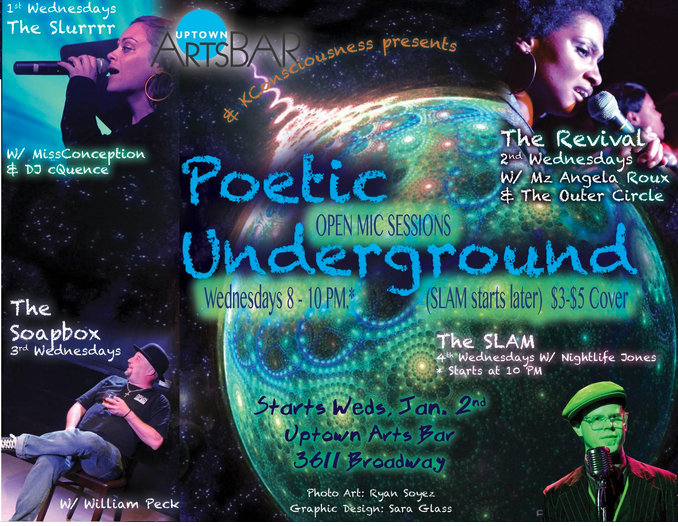
2012: The Birth of Poetic Underground
Here’s where our little history lesson gets personal. In the fall of 2012, Greg Patterson, who owned the building housing The Uptown Arts Bar, called Sara Nicole Glass with an idea. He wanted to bring more performance artists into that part of Kansas City. Would she be interested in starting a poetry open mic? Well, you don’t have to ask MissConception twice to get behind a microphone.
Sara reached out to Angela Roux, Doug E Fresh, Michael Rez Tommer, and Jeanette Powers (now Nettie Zan), assembling the original organizing group. Together, they brainstormed a name. Poetic Underground. And just like that, another Kansas City poetry community was born.
Sara was the original founder, and the name and early vision were developed collaboratively with the group she brought together. The idea was to create a welcoming space for poets, musicians, storytellers, and creative weirdos of every variety. A place where seasoned performers and first-timers could share the same stage. A place where people could experiment, connect, collaborate, and occasionally embarrass themselves in front of an appreciative audience. You know. Art.
From Underground to Institution
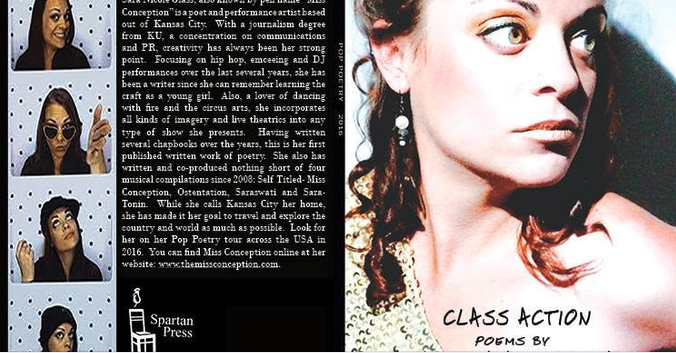
Poetic Underground grew. The room filled with poets. The audience developed its own vocabulary. There were slams, workshops, collaborations, friendships, publications, and enough metaphors to make Shakespeare request a smoke break. Jeanette Powers helped develop creative projects like the Prompts! anthology in 2016 and the Pop Poetry chapbook printing series that helped support authors getting their work out in print with Prospero’s Bookstore.
Later organizers, including Jenn Harris and Samantha Slupski, carried the community forward. Other spoken-word platforms emerged, including One Mic Stand KC in 2017. And when Uptown Arts Bar closed in 2019, Poetic Underground continued.
That’s the beautiful thing about building a creative community. If you do it right, it becomes bigger than you. It grows legs. It finds new homes. It develops new leadership. Sometimes it even develops a personality of its own. And sometimes that personality gets a little… particular.
The Curious Case of the Not-Quite-Open Mic
Over the past two years, I’ve stopped by a few Poetic Underground open mics, hoping to reconnect with the community I helped create. I was met with some rather interesting responses.
“Sorry, the list is full.” Fair enough. Open mics have time limits. Even poets have to go home eventually. On another occasion: “Nope, tonight is only for BIPOC poets.”
Now, I absolutely support creating dedicated spaces for Black, Indigenous, and other poets of color. Kansas City’s spoken-word history owes an enormous debt to Black artists and organizers, and those voices deserve to be celebrated and amplified. But I also believe there’s room to ask how an organization communicates its programming and welcomes the broader community. Because showing up to what you thought was an open mic and discovering that you aren’t eligible to perform can be a perplexing to say the least. Especially when you’re one of the people who started the thing. (I really don’t like to pull the “do you know who I am”? card).
It’s a bit like building a community garden, coming back years later with a watering can, and being told you’re not on the approved list of gardeners. I’m not suggesting every event must have an unrestricted sign-up sheet. Curated showcases, affinity spaces, and themed nights all have their place. But clarity, hospitality, and a little historical perspective go a long way.
And if we’re talking about inclusion, perhaps it’s worth remembering that inclusion is not just about who gets celebrated. It’s also about how we treat people when we tell them no.
A Spooky Little Plot Twist
Which brings us to October. As I prepare to leave Kansas City and move back to California at the beginning of Novemeber, I thought it would be fun to apply for Poetic Underground’s Spooky Showcase. I mean, come on. MissConception? Halloween? Spooky poetry? This practically writes itself. I’ve got plenty of fun, weird, witchy, ridiculous poems that would be perfect for the occasion. And what a lovely full-circle moment it could have been: one last performance with a community I helped launch before heading west. A little poetry. A little nostalgia. A little spooky silliness.
So, I applied. And, I was denied. Well, boo.
And not the fun Halloween kind. Of course, a curated showcase can’t include everyone, and I don’t know all the considerations that went into the selection process. Still, the irony was difficult to ignore. Apparently, even the ghosts of open mics past don’t automatically make the guest list.
A Heart of Glass and a Whole Lot of History
There’s another perspective on the complicated relationships that develop within creative communities in Nick’s blog, Heart of Glass. And that’s one reason I think it’s important to talk about our artistic history. Not just the polished version. Not just the anniversary posts and promotional flyers. But the human version.
The friendships. The collaborations. The disagreements. The people who started things, the people who sustained them, and the people who came along later and made them their own. Grassroots arts communities are messy. They’re made of artists, after all. People with big feelings, big ideas, fragile egos, enormous hearts, and sometimes a tendency to turn a scheduling conflict into a three-act tragedy. I say that with love. And professional experience.
Who Gets to Write the History?
One of the strangest things about community arts is how quickly origin stories can get lost.
People move. Venues close. Leadership changes. Websites disappear. Social media becomes the unofficial historical archive, which is terrifying because half of us can’t even remember our passwords. Suddenly, the people who founded something are footnotes, and the people currently running it become the entire story. But history doesn’t work that way.
Glenn North, Marcus Brown, and Jay Hawkins deserve recognition for Verbal Attack.
The Black Poets Collective and Urban Literation deserve recognition for their contributions.
The organizers of Danny’s Big Easy, Jazz Poetry Jams, One Mic Stand, and countless other gatherings deserve recognition.
And perhaps, I, Sara Nicole Glass deserve recognition as the original founder of Poetic Underground, alongside the original collaborators who helped shape it.
So do the people who kept it going after the founding group moved on.
Giving credit to the founders doesn’t take anything away from the people who came later.
There’s plenty of applause to go around.
So, What Does It Mean to Be Underground?
To me, the underground has never been about exclusivity. It’s about possibility. It’s about the weirdos, the outsiders, the first-timers, the truth-tellers, the hip-hop heads, the jazz cats, the slam poets, and the people who don’t fit neatly into any artistic category. It’s about creating a place where someone can walk into a room with a notebook and walk out feeling like they belong to something. That was the spirit behind Poetry Slurrrr. That was the spirit behind the founding of Poetic Underground. And it’s the spirit I hope continues to guide Kansas City’s spoken-word community long after I’ve headed west.
I’m proud of what we created. I’m grateful to the people who helped build it. I’m glad it survived, evolved, and continued providing opportunities for poets. And yes, I find it hilariously ironic that I haven’t managed to get back behind the microphone at the open mic I founded. But perhaps that’s just the universe handing MissConniption another poem. And believe me, darling, I’ve got a few.
The real legacy of a poetry community isn’t its logo, its leadership, or its sign-up sheet. It’s the people who found their voices there. So keep writing, Kansas City. Keep creating. Keep making room for the next generation (even when they don’t believe you that you are the person that founded their event).
And when somebody shows up with something different, maybe leave a little space for the unexpected. After all, you never know who might be standing at the door. It could be the next great poet laureate. It could be an old friend. It could even be a great misconception.
SPEAK POET!
With love, mischief, and just enough poetic indignation to keep things interesting,
MissConniption
Shout out and big thanks to ‘In the Lowest Ferns‘ venue, DJ E and Mark Hamblin’s Spirit Lifters for hosting the inclusive Read the Room Open Mic the last several months in the West Bottoms.

